
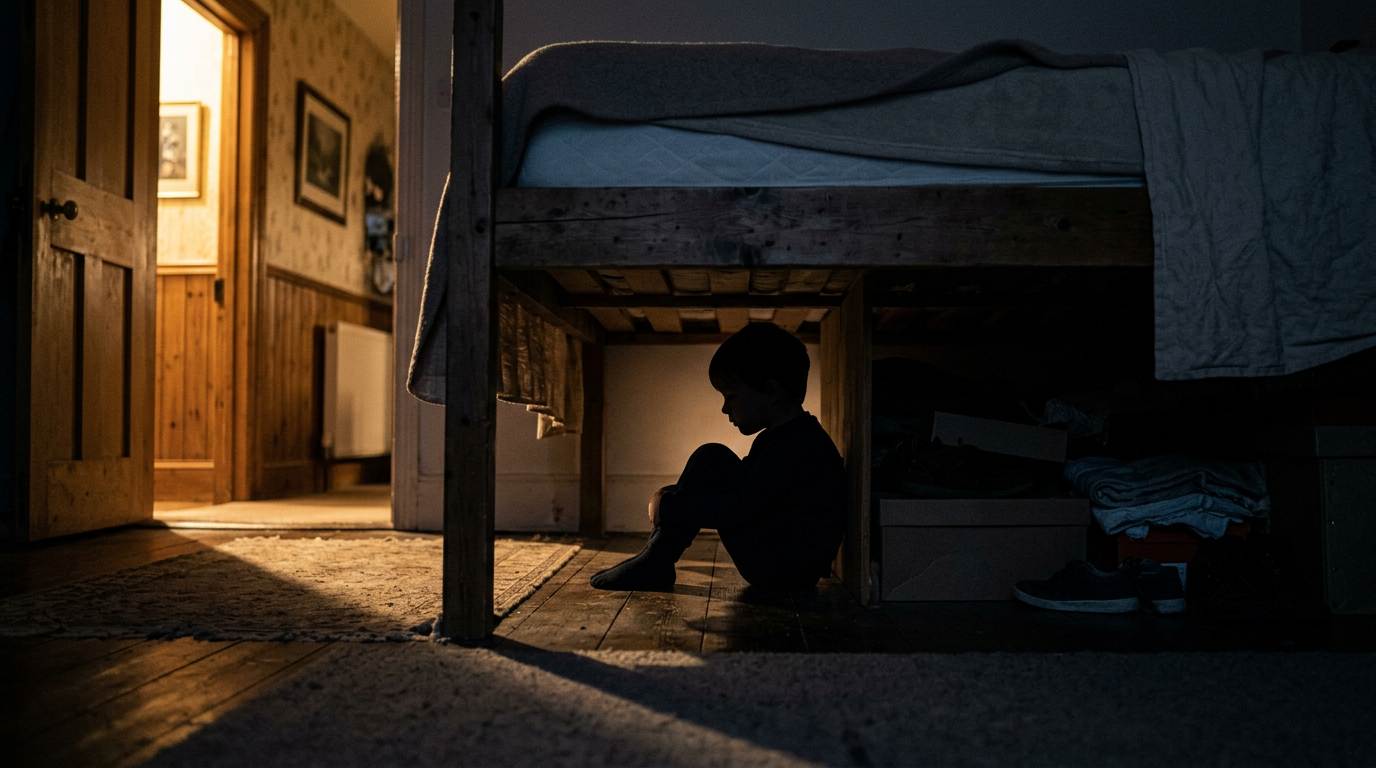


Some kids were obsessed with bicycles. Some with baseball cards, cartoons, or treehouses. Me? I was obsessed with hiding.
Not hide-and-seek.
Not the playful kind of hiding where someone counts to twenty while children laugh and scramble behind furniture waiting to be discovered. I mean real hiding. The kind where I did not want anyone to look for me at all. I wanted silence. Darkness. Distance. I wanted to disappear so completely that for a little while the world could not touch me.
As a child, I was always searching for places where I could be completely alone.
Closets were my favorite. I loved slipping inside and pulling the door shut until the room became dark except for thin lines of light around the frame. I would sit quietly among winter coats and hanging shirts, breathing in the smell of dust, old fabric, and cedar. Sometimes I stayed there so long my legs fell asleep beneath me, but I did not care. Inside closets, nobody expected anything from me. Nobody asked questions. Nobody watched me.
I hid under beds too.
There was something comforting about lying flat against the floor with only inches between my face and the mattress above me. The world sounded different under there. Softer. Distant. Safer. I would stare at forgotten things tucked against the wall — lost socks, old toys, dust gathered into soft gray islands — and feel calmer than I ever did in open rooms.
I made blanket forts constantly, not because I wanted adventure, but because I wanted enclosure. I wanted barriers between me and everyone else. Even then, before I understood anything about trauma or identity or fear, something inside me craved invisibility.
And what is strange is this obsession existed long before I was raped at ten years old.
People like clean explanations for pain. They want trauma to become the beginning of every fracture because it makes suffering easier to organize into a timeline. But the truth is messier than that. I was already hiding before the assault. I already preferred disappearing to participating. I already felt safer alone than exposed.
The rape did not create the hiding.
It confirmed it.
Even before it happened, I think part of me already believed visibility was dangerous.
I sensed I was different long before I had words for why. Children know things emotionally before they know them intellectually. I noticed everything. The tension in voices. The shift in moods. The way adults could fill a room with silence thicker than shouting. I became hyperaware of people the way stray animals become hyperaware of movement.
And somewhere deep inside me was the growing realization that the safest version of myself was the smallest one. The quietest one. The least noticeable one.
So I disappeared whenever I could.
After the rape, though, hiding changed. Before, it had been comforting. Afterward, it became survival.
At ten years old, something inside me split in two.
There became the visible version of me — the child who went to school, answered questions, smiled politely, acted normal, tried to succeed, tried to belong.
And then there was the hidden version of me.
The terrified one.
The ashamed one.
The confused one.
The one carrying something too enormous and terrifying to say out loud.
Trauma teaches children strange skills. It teaches you how to leave yourself while remaining physically present. It teaches you how to smile while silently unraveling. It teaches you how to become emotionally invisible even while standing directly in front of people.
And I became extraordinarily good at that invisibility.
I learned how to perform wellness. How to perform strength. How to perform faith. How to perform masculinity. How to perform whatever version of myself made other people comfortable enough not to look deeper.
That is the strange thing about hidden children: they often become highly functional adults.
People praise them constantly.
They call them mature. Responsible. Successful. Dependable. Compassionate. Faithful.
What they often fail to see is that underneath all that capability is someone who learned very early that being fully seen could cost them safety.
So you adapt.
You shape-shift.
You become who the room needs you to be.
And after enough years pass, you no longer know where the performance ends and you begin.
I think about that child often now. The child sitting silently in closets long before understanding why isolation felt comforting. The child who instinctively searched for hidden places before life gave him tangible reasons to hide. The child whose nervous system already seemed wired for retreat.
I do not hate that child anymore.
I ache for that child.
Because hiding made sense.
Hiding protected me when nothing else did.
But it also came with a cost.
No one can fully love a person they cannot fully see.
And if you spend decades surviving through invisibility, eventually loneliness settles into your bones like winter cold. There is an exhaustion that comes from spending your entire life editing yourself for the comfort of others. There is grief in realizing how much of your life was spent trying not to take up space.
Even now, there are days when I still want to disappear. Not because I want to die, but because some wounded part of me still believes solitude equals safety. There are moments when I crave small rooms, locked doors, silence, darkness, isolation — all the old hiding places that once made the world feel survivable.
Trauma echoes long after the moment itself ends.
But healing, I think, is slowly learning something different.
Healing is realizing that visibility does not always end in destruction.
Healing is discovering that maybe being known will not kill you.
Healing is understanding that the child who hid was never weak or broken or strange. That child was adapting the only way they knew how. That child deserved protection long before they learned to protect themselves through disappearance.
For most of my life, hiding felt like freedom.
Now I think freedom might actually be this:
No longer needing to disappear in order to survive.

Leave a Reply